I often show disgust for today's most successful musicians. I'm trying to get a degree in music so that I can make below the poverty line a year and there are extremely untalented people out there, AKA some pop stars, who can't sing a pitch to save their lives but are wealthy and famous as musicians. Why? They suck! Ever heard Avril Lavigne sing live? It'll make you tear your hair out.
Having said that, people who have received zero training in music can also be fantastic musicians. Don't think I'm being a snob and saying that you need to go to school to be great. Many of the musicians I like best have never studied music formally.
My friend Kori, for example. If I had to endorse one musician, this guy is the one. He really knows what he's doing with a guitar, like he was born with one in hand, and his voice is both very expressive and on pitch with a drop of honey to lure you in.
Go ahead, listen to what he's got on MySpace, and order his album. Many young Canadian artists claim to be unique in their style but this one is real, and this is the kind of musician we should all be supporting.
Thursday, June 4, 2009

Wednesday, June 3, 2009
Gym? I hate the gym.
It's true, I hate gyms. I've always hated them. Every gym I've ever set foot in, I've hated immediately.
Now I like the gym. I think it's a miracle I've had this change of heart, and it's for the better. My boyfriend started going to the gym on campus and loved it so much that he convinced me to come with him and buy a month's membership on my first day.
This gym is really nice, although all I've seen is the weight room. The weight room has two sides: a woman's side, where all the women go (treadmills, elipticals, stationary bikes, mats, and a few pieces of equipment), and the men's side, where all the men go and very few women (dumbells and barbells).
I've figured out why there's this great divide with only a few exceptions. The kinds of exercises that go on in the free weight side of the gym are very hard for women to do. We have a tiny fraction of the strength a man has naturally, so all the exercises are awkward and hard for us even with an empty bar. I persevere.
One of the things my boyfriend was teaching me to do are the clean and jerk. In the olympics, there are two weightlifting events that every competitor must do: the clean and jerk, and the snatch. The snatch is the one with a wide grip, where the weight comes up off the floor and straight above your head with only one squat. The clean and jerk uses more weight, and is broken into three mini-parts: the deadlift, which gets the weight up to your hips; the clean, which gets the weight up to your shoulders; and the jerk, which gets it above your head.
Deadlifts? Those were easy to do. Not easy with a lot of weight, but for my first times with everything, I was using either an empty bar or one with very little weight. The clean kills me though. I'm terrible at it. You have to jump and get under the bar, letting the weight fall onto your meaty chest & shoulders. In my case, the bar falls right onto my sternum, so I'm easing the bar down with my arms to protect my chest. There has to be a better way to do this?
I found out that I was really good at jerks, which is enough motivation to get me to keep working on my cleans. I figured out that I do best with a split jerk, probably because I like jumping with one foot instead of two, and I'd rather lunge than squat because I have terrible knees.
This is not all I do at the gym, but I will definitely be monitering my improvements in those exercises very closely. Gym? I love the gym!
Now I like the gym. I think it's a miracle I've had this change of heart, and it's for the better. My boyfriend started going to the gym on campus and loved it so much that he convinced me to come with him and buy a month's membership on my first day.
This gym is really nice, although all I've seen is the weight room. The weight room has two sides: a woman's side, where all the women go (treadmills, elipticals, stationary bikes, mats, and a few pieces of equipment), and the men's side, where all the men go and very few women (dumbells and barbells).
I've figured out why there's this great divide with only a few exceptions. The kinds of exercises that go on in the free weight side of the gym are very hard for women to do. We have a tiny fraction of the strength a man has naturally, so all the exercises are awkward and hard for us even with an empty bar. I persevere.
One of the things my boyfriend was teaching me to do are the clean and jerk. In the olympics, there are two weightlifting events that every competitor must do: the clean and jerk, and the snatch. The snatch is the one with a wide grip, where the weight comes up off the floor and straight above your head with only one squat. The clean and jerk uses more weight, and is broken into three mini-parts: the deadlift, which gets the weight up to your hips; the clean, which gets the weight up to your shoulders; and the jerk, which gets it above your head.
Deadlifts? Those were easy to do. Not easy with a lot of weight, but for my first times with everything, I was using either an empty bar or one with very little weight. The clean kills me though. I'm terrible at it. You have to jump and get under the bar, letting the weight fall onto your meaty chest & shoulders. In my case, the bar falls right onto my sternum, so I'm easing the bar down with my arms to protect my chest. There has to be a better way to do this?
I found out that I was really good at jerks, which is enough motivation to get me to keep working on my cleans. I figured out that I do best with a split jerk, probably because I like jumping with one foot instead of two, and I'd rather lunge than squat because I have terrible knees.
This is not all I do at the gym, but I will definitely be monitering my improvements in those exercises very closely. Gym? I love the gym!
Sunday, May 31, 2009
My Top Five Dog Breeds
Today I share with you a few of my favourite dog breeds!
This breed of dog is near and very dear to my heart. Over the winter of 1995-1996, a friend of the family helped us pick the perfect breed of dog for our family of five. I don't think any of us had heard about the Border Collie but the criteria matched: medium size, intelligent, little grooming, good health, and doesn't bark a lot. By chance, a breeder was moving to our city that spring, so in June of 1996, we picked up our 6 week old Border Collie named Shadow.
When the breeder opened the back of her truck, the puppy jumped down and sprinted about 100m away and then came right back just as fast. Border Collies are fast dogs, with unlimited energy.

Shadow at 9 years
They are between 18 and 22 inches tall, with our dog being on the lower end of the spectrum, and they can come in many different colour patterns because they were bred as a working dog, not a showing dog. Only recently have they been accepted into the AKC. Our dog is a tri-colour, meaning that she's black, white, and a bit of tan. Some have equal parts of all three colours, or they can be a red Border Collie, which means that they are brown and white like Australian Shepherds. Another coat pattern, merle (either blue or red), mixes black or brown hair with white so that the dog looks spotted. I prefer mostly black dogs but their variance in colour make them unique even amongst themselves.

Shadow at 10 years, a rare sleepy moment
Shadow likes to nip, and always has. They are a sheep and cattle herding dog, after all. We trained ours the command "gentle", which turned out to be very useful. You can't touch her when she's in a playing mood, but if you say gentle, she will sit nicely while you pet her, and possibly lick instead of bite. We taught her a whole array of other tricks too, and on a whim, entered her in a trick competition where she won first place. It's no surprise that the Border Collie is rated as the smartest dog in the world! She even does her business on command, and it only took her two tries to be house broken.
Beware: This dog needs constant mental stimulation and exercise. Catching a frisbee is perfect, especially if you get them to do tricks with it. Shadow's favourite game was chasing a remote controlled car because it would go fast, slow, and turn unexpectedly, and she would herd it. She also likes to herd other dogs, which doesn't get her a lot of friends. She gets along well enough with dogs who don't care that she'll circle them for hours, but if a dog tries to interrupt her work, she'll get rough.
Border Collies live a pretty long time, with an average lifespan of 12 years. Shadow just celebrated her 13th birthday and pictured below is her just before that birthday while on a difficult hike. Her vision and hearing are fine, but she does show her age in jumping to catch frisbees now.

Shadow at 13 years; notice the eyebrows? She'll cock her head at you and move one eyebrow.

While searching for our perfect dog, I noticed this one in our dog breed book and I was lucky to meet one last year.
What first attracted me to this dog was their appearance. They are a large dog, and as you can see from the picture, they are tri-colour. All of them. The Bernese Mountain Dog is a Swedish dog bred for pulling small carts and for guarding livestock. How big does a dog need to be to pull a cart? These dogs are between 23 and 28 inches high and weigh between 65 and 120lbs. Under all that fur is a very strong dog, and they do grow up quickly.
Anyone considering this dog will be happy to know that they rank 22 out of 79 in terms of breed intelligence, meaning that they understand new commands fairly quickly and obey the first command often. In comparison, the Saint Bernard ranks 65, which seems fairly low for a search and rescue dog.
Bernese Mountain Dogs are very playful but they aren't as energetic as the Border Collie. You must teach your Bernese to stay off of people from the very start, because they grow to be 90-100lbs while they are a puppy. They are excellent dogs for children because they are patient and will lay quietly but also fetch a ball quite happily. They don't bark much, except when they're very excited.
Golden Retrievers are usually everyone's favourite family dog, but if you want something a little diferent, go with the Bernese. Be warned though that because they are a large dog and purebred, they tend to have shorter lives than most dogs of their size. Most dogs in their class live to be 10 or 11 but these dogs usually live to be 7 to 9 years, with arthritis and hip problems occuring at around 4 to 5 years and cancer taking the life of approximately 50% of them (compared to 27% average for other breeds).
In spite of the health problems, I still place this dog in the #2 slot because of its temperament. You will be hard pressed to find a more tolerant, patient, loyal and friendly dog than this. Some owners train their dogs to pull small carts with children in them and you might see a few in a parade some day.
German Shepherd

Now here's a popular dog, but why is that? This is a dog who was bred for herding sheep, so why are they so popular in urban settings?
Some dogs, like retrievers, have teeth placed in a way so that when they are retrieving a duck, they will not damage the body. German Shepherds' teeth are aligned in a way so that they act like 21 pairs of scissors, which they call a "scissor bite". As a slightly larger dog (22-26", 49-88lbs), they have a strong jaw and a very powerful body. They are built "uphill", meaning that their shoulders are higher than their hips. You can just imagine the power of those hind legs as he jumps to take down an intruder, no?
It's no surprise to find the German Shepherd in so many homes. Like all dogs, he can hear approximately 7 times better than a human but unlike most dogs, if he hears someone breaking and entering, he will do something about it. Can an alarm system do that? Absolutely not. German Shepherds, therefore, offer great peace of mind as guard dogs and are often cross-bred with Rottweilers. This also makes him a popular choise for police, military or other emergency response.
He is also a dog you will want if you have children. They are playful, gentle, patient, loyal, and very intelligent at 3 out of 79 on our breed intelligence list. I would actually say that this dog is more obedient than a Border Collie because he is less easily distracted!
German Shepherds are easily recognizable by their long muzzle, erect ears, low hips and long body, and they usually come in tan with black markings, although all black and even solid white German Shepherds occur as well.
Unfortunately, the German Shepherd went through much inbreeding. In the 19th Century, German shepherds (the people) started breeding dogs that they thought exhibited good traits and by 1899, a Germany-wide breeding effort produced the modern German Shepherd. What this means is that almost all the dogs in this breed will have hip problems as they get older. Fortunately, they have an average lifespan for their size, being 7 to 10 years. So if you want a very versatile dog, this is the one.
Belgian Shepherd

Isn't that a handsome dog? Belgian Shepherds do come in four very different varieties but I would like to focus on the variety which is officially called "Belgian Shepherd" in the AKC, being the Groenendael.
This is an extremely athletic dog. If you don't have an acreage, don't even think about having this one. Oddly, in spite of his double coat and rustic appearance, he is not an outdoor dog. He bonds really well with his masters. So well, in fact, that he gets separation anxiety when he is away from his owner for too long! How's that for loyalty?
He is also very intelligent, ranking 15 out of 79. Not bad. He is rather easy to train, but the owner should establish very early that he is boss and why he should be boss. "Because I said so" doesn't go over well with these dogs, so as odd as it sounds, you have to demonstrate to him why you are a good leader and make good decisions for him.
The Belgian Shepherd is another dog you want to train at an early age not to jump on people. Not only is he big, but he is also a shedder. Someone wishing to own a Belgian Shepherd should invest in dark clothes (unlike the owner of a Border Collie, who will just have to get used to black hair sticking to light clothes and white hair sticking to dark clothes). In terms of grooming, he doesn't require much except when he's shedding. Because of his undercoat, you will want to invest in special tools to help get all that hair out.
If lifespan is something that worries you, have no fears here: this dog has an above average lifespan for his size, being about 12 years even if he's a purebred. Their health in general is good, with less hip problems than their German neighbours, but Belgian Shepherds do have a higher incidence of epilepsy and seizures. The prospect of an epileptic dog might sound a bit scary but it is certainly a better condition than terminal cancer. There are prescriptions to manage epilepsy in dogs.
Between the above average intelligence, classy all-black coat and collie-like regal appearance, this was an easy decision for my top five list!
Weimaraner

The final dog on my top five list is the Weimaraner, who, as his name suggests, was bred in Weimar, Germany. He was bred for the Grand Duke of Weimar, Karl August, to be a suberb hunting dog.
Every aspect of the Weim's appearance screams "hound". He has a large nose with a keen sense of smell, large and floppy ears, and a sleek, athletic body. He comes in two colours: blue, which is shunned in the show ring, and grey, which gets him the nickname "grey ghost".
At 21 out of 79, the Weimaraner ranks just above the Belgian Shepherd in terms of intelligence, but he sometimes uses this intelligence the wrong way. They are known to steal food from a table or create their own fun if they are left alone in a house, especially as puppies, by chewing on things. They will also instinctively chase anything that moves, but all of these traits can be curbed if trained from an early age and provided plenty of opportunities to run.
If you are camera happy, this is the dog for you! Photographer William Wegman discovered the photogenic nature of Weims after snapping a few shots of his own dog. They pose very well, especially in human clothes, making for some very entertaining shots, such as the one below:

They are usually between 23 and 27 inches tall and weigh between 70 and 85lbs, which is rather light for their size. He is also very loyal and makes an excellent guard dog if that is high on your priority list. If you plan on getting more animals after purchasing a Weimaraner, think again. The do well when they are introduced to other animals as a puppy but they are infamously bad at accepting other animals in the house when they are older. Another important thing to note is that like the Belgian Shepherd, he also suffers separation anxiety so don't buy him a kennel. In a time when most hunting dogs were kenneled, the Weimaraner got to live with the family so don't deny him a comfort he's had since the beginning of the breed.
Visit William Wegman's website to see some other great shots of the Weimaraner. He is a bit of an authority on the breed and has been featured on many shows, including Sesame Street, Saturday Night Live and Dogs 101.
- Border Collie
- Bernese Mountain Dog
- German Shepherd
- Belgian Shepherd
- Weimaraner
Border Collie

Shadow at 6 weeks
This breed of dog is near and very dear to my heart. Over the winter of 1995-1996, a friend of the family helped us pick the perfect breed of dog for our family of five. I don't think any of us had heard about the Border Collie but the criteria matched: medium size, intelligent, little grooming, good health, and doesn't bark a lot. By chance, a breeder was moving to our city that spring, so in June of 1996, we picked up our 6 week old Border Collie named Shadow.
When the breeder opened the back of her truck, the puppy jumped down and sprinted about 100m away and then came right back just as fast. Border Collies are fast dogs, with unlimited energy.

Shadow at 9 years
They are between 18 and 22 inches tall, with our dog being on the lower end of the spectrum, and they can come in many different colour patterns because they were bred as a working dog, not a showing dog. Only recently have they been accepted into the AKC. Our dog is a tri-colour, meaning that she's black, white, and a bit of tan. Some have equal parts of all three colours, or they can be a red Border Collie, which means that they are brown and white like Australian Shepherds. Another coat pattern, merle (either blue or red), mixes black or brown hair with white so that the dog looks spotted. I prefer mostly black dogs but their variance in colour make them unique even amongst themselves.
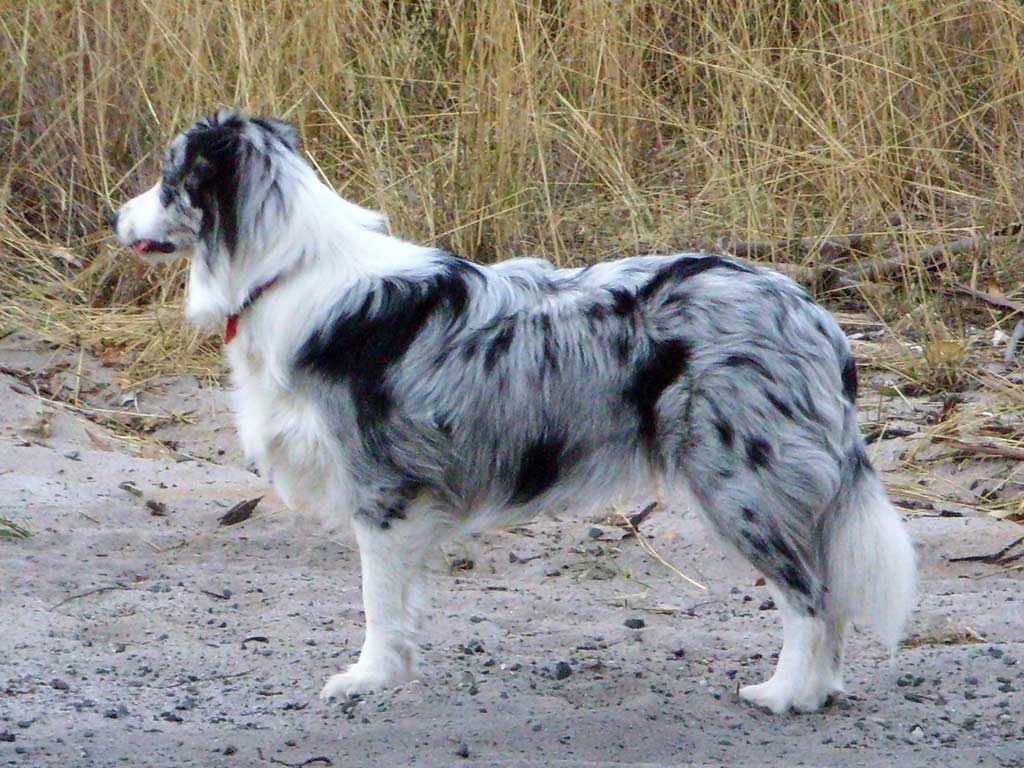


Shadow at 10 years, a rare sleepy moment
Shadow likes to nip, and always has. They are a sheep and cattle herding dog, after all. We trained ours the command "gentle", which turned out to be very useful. You can't touch her when she's in a playing mood, but if you say gentle, she will sit nicely while you pet her, and possibly lick instead of bite. We taught her a whole array of other tricks too, and on a whim, entered her in a trick competition where she won first place. It's no surprise that the Border Collie is rated as the smartest dog in the world! She even does her business on command, and it only took her two tries to be house broken.
Beware: This dog needs constant mental stimulation and exercise. Catching a frisbee is perfect, especially if you get them to do tricks with it. Shadow's favourite game was chasing a remote controlled car because it would go fast, slow, and turn unexpectedly, and she would herd it. She also likes to herd other dogs, which doesn't get her a lot of friends. She gets along well enough with dogs who don't care that she'll circle them for hours, but if a dog tries to interrupt her work, she'll get rough.
Border Collies live a pretty long time, with an average lifespan of 12 years. Shadow just celebrated her 13th birthday and pictured below is her just before that birthday while on a difficult hike. Her vision and hearing are fine, but she does show her age in jumping to catch frisbees now.

Shadow at 13 years; notice the eyebrows? She'll cock her head at you and move one eyebrow.
Bernese Mountain Dog

While searching for our perfect dog, I noticed this one in our dog breed book and I was lucky to meet one last year.
What first attracted me to this dog was their appearance. They are a large dog, and as you can see from the picture, they are tri-colour. All of them. The Bernese Mountain Dog is a Swedish dog bred for pulling small carts and for guarding livestock. How big does a dog need to be to pull a cart? These dogs are between 23 and 28 inches high and weigh between 65 and 120lbs. Under all that fur is a very strong dog, and they do grow up quickly.
Anyone considering this dog will be happy to know that they rank 22 out of 79 in terms of breed intelligence, meaning that they understand new commands fairly quickly and obey the first command often. In comparison, the Saint Bernard ranks 65, which seems fairly low for a search and rescue dog.
Bernese Mountain Dogs are very playful but they aren't as energetic as the Border Collie. You must teach your Bernese to stay off of people from the very start, because they grow to be 90-100lbs while they are a puppy. They are excellent dogs for children because they are patient and will lay quietly but also fetch a ball quite happily. They don't bark much, except when they're very excited.
Golden Retrievers are usually everyone's favourite family dog, but if you want something a little diferent, go with the Bernese. Be warned though that because they are a large dog and purebred, they tend to have shorter lives than most dogs of their size. Most dogs in their class live to be 10 or 11 but these dogs usually live to be 7 to 9 years, with arthritis and hip problems occuring at around 4 to 5 years and cancer taking the life of approximately 50% of them (compared to 27% average for other breeds).
In spite of the health problems, I still place this dog in the #2 slot because of its temperament. You will be hard pressed to find a more tolerant, patient, loyal and friendly dog than this. Some owners train their dogs to pull small carts with children in them and you might see a few in a parade some day.
German Shepherd
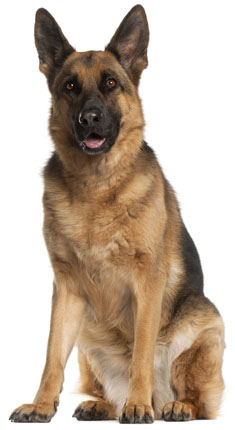
Now here's a popular dog, but why is that? This is a dog who was bred for herding sheep, so why are they so popular in urban settings?
Some dogs, like retrievers, have teeth placed in a way so that when they are retrieving a duck, they will not damage the body. German Shepherds' teeth are aligned in a way so that they act like 21 pairs of scissors, which they call a "scissor bite". As a slightly larger dog (22-26", 49-88lbs), they have a strong jaw and a very powerful body. They are built "uphill", meaning that their shoulders are higher than their hips. You can just imagine the power of those hind legs as he jumps to take down an intruder, no?
It's no surprise to find the German Shepherd in so many homes. Like all dogs, he can hear approximately 7 times better than a human but unlike most dogs, if he hears someone breaking and entering, he will do something about it. Can an alarm system do that? Absolutely not. German Shepherds, therefore, offer great peace of mind as guard dogs and are often cross-bred with Rottweilers. This also makes him a popular choise for police, military or other emergency response.
He is also a dog you will want if you have children. They are playful, gentle, patient, loyal, and very intelligent at 3 out of 79 on our breed intelligence list. I would actually say that this dog is more obedient than a Border Collie because he is less easily distracted!
German Shepherds are easily recognizable by their long muzzle, erect ears, low hips and long body, and they usually come in tan with black markings, although all black and even solid white German Shepherds occur as well.
Unfortunately, the German Shepherd went through much inbreeding. In the 19th Century, German shepherds (the people) started breeding dogs that they thought exhibited good traits and by 1899, a Germany-wide breeding effort produced the modern German Shepherd. What this means is that almost all the dogs in this breed will have hip problems as they get older. Fortunately, they have an average lifespan for their size, being 7 to 10 years. So if you want a very versatile dog, this is the one.
Belgian Shepherd

Isn't that a handsome dog? Belgian Shepherds do come in four very different varieties but I would like to focus on the variety which is officially called "Belgian Shepherd" in the AKC, being the Groenendael.
This is an extremely athletic dog. If you don't have an acreage, don't even think about having this one. Oddly, in spite of his double coat and rustic appearance, he is not an outdoor dog. He bonds really well with his masters. So well, in fact, that he gets separation anxiety when he is away from his owner for too long! How's that for loyalty?
He is also very intelligent, ranking 15 out of 79. Not bad. He is rather easy to train, but the owner should establish very early that he is boss and why he should be boss. "Because I said so" doesn't go over well with these dogs, so as odd as it sounds, you have to demonstrate to him why you are a good leader and make good decisions for him.
The Belgian Shepherd is another dog you want to train at an early age not to jump on people. Not only is he big, but he is also a shedder. Someone wishing to own a Belgian Shepherd should invest in dark clothes (unlike the owner of a Border Collie, who will just have to get used to black hair sticking to light clothes and white hair sticking to dark clothes). In terms of grooming, he doesn't require much except when he's shedding. Because of his undercoat, you will want to invest in special tools to help get all that hair out.
If lifespan is something that worries you, have no fears here: this dog has an above average lifespan for his size, being about 12 years even if he's a purebred. Their health in general is good, with less hip problems than their German neighbours, but Belgian Shepherds do have a higher incidence of epilepsy and seizures. The prospect of an epileptic dog might sound a bit scary but it is certainly a better condition than terminal cancer. There are prescriptions to manage epilepsy in dogs.
Between the above average intelligence, classy all-black coat and collie-like regal appearance, this was an easy decision for my top five list!
Weimaraner

The final dog on my top five list is the Weimaraner, who, as his name suggests, was bred in Weimar, Germany. He was bred for the Grand Duke of Weimar, Karl August, to be a suberb hunting dog.
Every aspect of the Weim's appearance screams "hound". He has a large nose with a keen sense of smell, large and floppy ears, and a sleek, athletic body. He comes in two colours: blue, which is shunned in the show ring, and grey, which gets him the nickname "grey ghost".
At 21 out of 79, the Weimaraner ranks just above the Belgian Shepherd in terms of intelligence, but he sometimes uses this intelligence the wrong way. They are known to steal food from a table or create their own fun if they are left alone in a house, especially as puppies, by chewing on things. They will also instinctively chase anything that moves, but all of these traits can be curbed if trained from an early age and provided plenty of opportunities to run.
If you are camera happy, this is the dog for you! Photographer William Wegman discovered the photogenic nature of Weims after snapping a few shots of his own dog. They pose very well, especially in human clothes, making for some very entertaining shots, such as the one below:
They are usually between 23 and 27 inches tall and weigh between 70 and 85lbs, which is rather light for their size. He is also very loyal and makes an excellent guard dog if that is high on your priority list. If you plan on getting more animals after purchasing a Weimaraner, think again. The do well when they are introduced to other animals as a puppy but they are infamously bad at accepting other animals in the house when they are older. Another important thing to note is that like the Belgian Shepherd, he also suffers separation anxiety so don't buy him a kennel. In a time when most hunting dogs were kenneled, the Weimaraner got to live with the family so don't deny him a comfort he's had since the beginning of the breed.
Visit William Wegman's website to see some other great shots of the Weimaraner. He is a bit of an authority on the breed and has been featured on many shows, including Sesame Street, Saturday Night Live and Dogs 101.
Saturday, May 30, 2009
Speaking with Horses
This post is about horses, and how little we actually know about them.
I've been around a lot of horses at many stables and farms. I've seen horses of all shapes and sizes performing all kinds of tasks, from show jumping to gymkhana to pulling a plough. I've always wondered: how do you get a horse to accept the halter, then to accept a bridle and all the rest of his tack? Even "well-trained" horses are hard to stick a halter on when they're out roaming in their paddock, and even these "well-trained" horses do little things to annoy us, like nipping while we do up the girth or walking forward while we're mounting.
When a horse nips or spooks, what do we do? We slap them or yank on the lead line. When a horse really misbehaves - that is, puts us in danger - we beat them silly. I will never forget one riding instructor I had, who beat my favourite horse with a girth when the horse accidentally pushed me because another horse nipped at her. I vowed I would never do this.
As a child, I made it halfway through Monty Roberts' book The Man Who Listens to Horses. This man watched wild horses communicate with each other in a herd setting. What did he notice? They don't yell at each other or beat each other silly with leather implements. They use body language to establish who is boss, and their main form of discipline is by chasing a bad horse away from the herd, where he's vulnerable to predators, and keeping him there until he starts showing the signs of apology.
Here's a video of some pretty nice looking ponies and people who have no idea how to lead these spirited animals. Watch how they yank on the lead lines and stand facing the horse in a menacing way when the horse stops walking behind them. The trouble with the right turn is that the horse has to be slightly behind you and paying attention to where you are, not spooking when you walk into him. They're acting more like predators than like someone the horse should gladly walk behind!
In summary, maybe we should learn to communicate with horses a little better because right now, all they hear is "wah wah wah wah" and they get punished when they don't understand.
I've been around a lot of horses at many stables and farms. I've seen horses of all shapes and sizes performing all kinds of tasks, from show jumping to gymkhana to pulling a plough. I've always wondered: how do you get a horse to accept the halter, then to accept a bridle and all the rest of his tack? Even "well-trained" horses are hard to stick a halter on when they're out roaming in their paddock, and even these "well-trained" horses do little things to annoy us, like nipping while we do up the girth or walking forward while we're mounting.
When a horse nips or spooks, what do we do? We slap them or yank on the lead line. When a horse really misbehaves - that is, puts us in danger - we beat them silly. I will never forget one riding instructor I had, who beat my favourite horse with a girth when the horse accidentally pushed me because another horse nipped at her. I vowed I would never do this.
As a child, I made it halfway through Monty Roberts' book The Man Who Listens to Horses. This man watched wild horses communicate with each other in a herd setting. What did he notice? They don't yell at each other or beat each other silly with leather implements. They use body language to establish who is boss, and their main form of discipline is by chasing a bad horse away from the herd, where he's vulnerable to predators, and keeping him there until he starts showing the signs of apology.
Here's a video of some pretty nice looking ponies and people who have no idea how to lead these spirited animals. Watch how they yank on the lead lines and stand facing the horse in a menacing way when the horse stops walking behind them. The trouble with the right turn is that the horse has to be slightly behind you and paying attention to where you are, not spooking when you walk into him. They're acting more like predators than like someone the horse should gladly walk behind!
In summary, maybe we should learn to communicate with horses a little better because right now, all they hear is "wah wah wah wah" and they get punished when they don't understand.
Subscribe to:
Posts (Atom)